

The Fundamentals of Project Management: A Comprehensive overview
Project management acts as an anchor for bridging ideas and execution within business. It requires the completion of a specified task with the correct planning, organizing, and management of resources within a set time. This article examines the definitions, modern practices, and strategies of project management and how they contribute to project success.
Understanding Project Management
In principle, project management is the combination of knowledge, experience, competencies, and other tools and techniques that are needed to meet a project’s goal. Projects are defined as time-bound tasks that are set to achieve goals with certain limits. Projects are different from routine tasks in their uniqueness because they are aimed at completing specific objectives that result in the creation of a service, product, or other outcome. This helps in delivering the outcome in the shortest time possible and within the budget and resources provided.
The Importance of Project Management
The management of projects plays an essential aspect in ensuring the success of both personal and professional endeavors. Through a systematic process, it assists:
- Define objectives: The goals are clearly defined to ensure that everyone knows what the intended outcomes are.
- Optimize Resources: A well-organized project management system ensures that money, time, and human resources are effectively utilized.
- Mitigate Risks: Preparing for potential problems and preparing contingency plans can help avoid interruptions.
- Enhance Collaboration: It encourages teamwork by clearly defining the roles, responsibilities, as well as communication channels.
5. Achieve Customer Satisfaction: Providing timely and quality results increases trust and builds confidence with the stakeholders.
Popular Project Management Methodologies
All projects are different and so are the approaches used for them. A single methodology is not sufficient for all needs. Let’s explore some of the methodologies that are widely adopted around the globe:
- Water Fall Methodology: This is a sequential, step-by-step approach focusing on the following steps: project initiation, planning, execution, and closure. It is effective when the project processes and goals are clear-cut.
- Agile Methodology: Agile is ideal for projects that truly require an evolution in design, content, and functionality, especially feedback-driven projects like software development. Agile focuses on iterative and incremental progress.
- Scrum Framework: Scrum is a sub-type of Agile that aids in breaking the project into smaller iterations known as sprints and helps in rapid delivery.
- Kunban System: To streamline tasks and limit the amount spent on any single project, Kanban utilizes visual boards that allow teams to manage workflow effectively.
- Hybrid Approach: Tailored to meet the specific needs of a project, the hybrid approach incorporates elements from multiple methodologies.
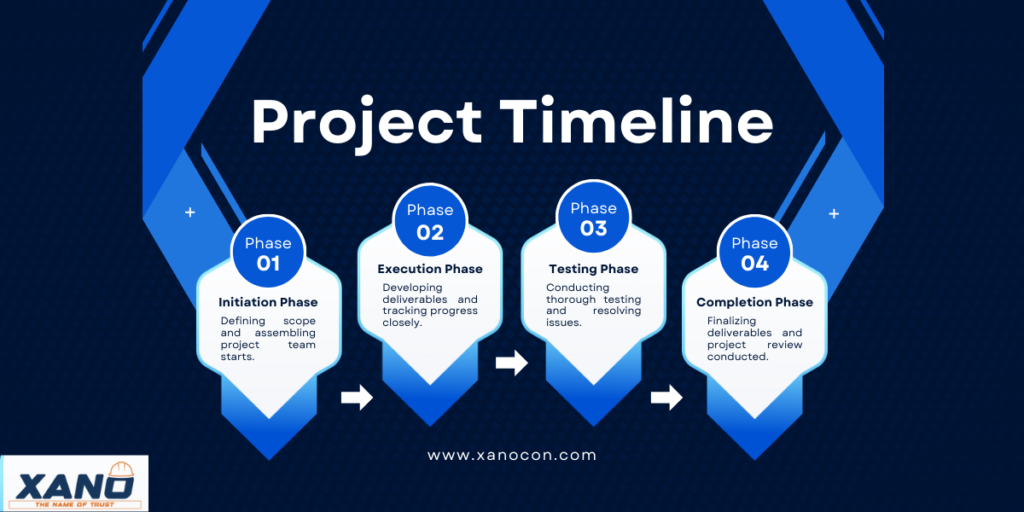
The phases of Project management
Four Key Phases of Project management are all critical to the overall success of a project: 1. Initiation: This phase defines the reason for the project’s existence, the deliverables, the outcomes, and the scope of the project. Identify stakeholders and produce a feasibility study or business case to evaluate the viability of the project
2. Planning: This is the top level where the planning of detailed strategies happens. This will involve allocating tasks, developing timetables, planning resources, and assessing risks. It is also important to set clear deliverables and performance metrics.
3. Execution: The project plan is implemented during execution. This is how teams perform their functions, and managers check progress, making sure the work stays aligned with the objectives. To keep the momentum going, looking at ways to communicate and collaborate more effectively is key.
4. Monitoring and Controlling: In this phase, the project’s progress is tracked and necessary adjustments are made. The plan includes establishing baselines and performance measurements that guide alteration and allow deviation to keep on track. 5. Closure: The last part involves evaluating the project’s results, documenting lessons learned, and celebrating success. Deliverables are delivered, and all project activities are closed out.
Challenges in Project Management
However, project management has many advantages as well as challenges. Some common hurdles include:
1. Scope Creep: Uncontrolled changes to the scope of a project can delay its progress and blow its budget. This risk can be minimized by clearly defining project scope and establishing procedures for managing change.
2. Resource Constraints: These can only be accomplished through great efforts, such as working to turbo charge one or more of the following. This can be mitigated by prioritizing tasks and optimizing resource allocation.
3. Communication Issues: If communication between the employees is not proper, it can result in conflicts and mistakes. Plan ahead for communication. It helps to set very clear communication protocols, and collaboration tools can help.
4. Risk Management: People Say that Projects are not easy; the risk is always there. This can be widely countered by executing proper risk assessments and planning for contingencies.
The Future of Project Management
The world of project management is an ever-evolving place with technology and work surroundings changing all over the place. Growing trends are using artificial intelligence (AI) and machine learning for predictive analytics, automating repetitive tasks, and making decisions based on data. In addition, remote work increases dependence on digital tools, thus accelerating the shift towards virtual collaboration.
Moreover, sustainability and social responsibility are increasingly emphasized. This trend is reshaping management, as it embeds values like environmental significance and ethics within the process of project delivery; one that touches the very definition of what is being done in a project.
Conclusion
In the rapidly changing world that we live in now, project management is that skill that is not an optional one. It provides a framework of structured methodologies, tools and best practices, helping organizations and individuals lead more productive lives. So, whether it’s a small group you’re leading or something more complex, learning project management will help ensure successful, innovative, valuable outcomes.